




Fetal Doppler Baby Heart Monitor
fetal doppler baby heart monitor
1. FHR Measuring Range:65~210bpm
2. Frequency:2.50MHz
3. Accuracy: ± 2 BPM
4. Power Consumption:< 0.8 W
5. Suitable for use after the 12th week of pregnancy
- Fast Delievery
- Quality Assurance
- 24/7 Customer Service
Description
Product Description
The new generation of intelligent fetal heart monitors covers the functions of traditional fetal heart monitors. It is not only to listen to the fetal heart, but also to meet the standards of family fetal heart monitoring, draw monitoring curves, count fetal heart rate and fetal movement, share with doctors for remote assistance, etc., and is used in combination with mobile phone software.
What are the two most common methods of checking fetal heart tones?
There are two methods of fetal heart rate monitoring in labor. Auscultation is a method of periodically listening to the fetal heartbeat. Electronic fetal monitoring is a procedure in which instruments are used to continuously record the heartbeat of the fetus and the contractions of the woman's uterus during labor.
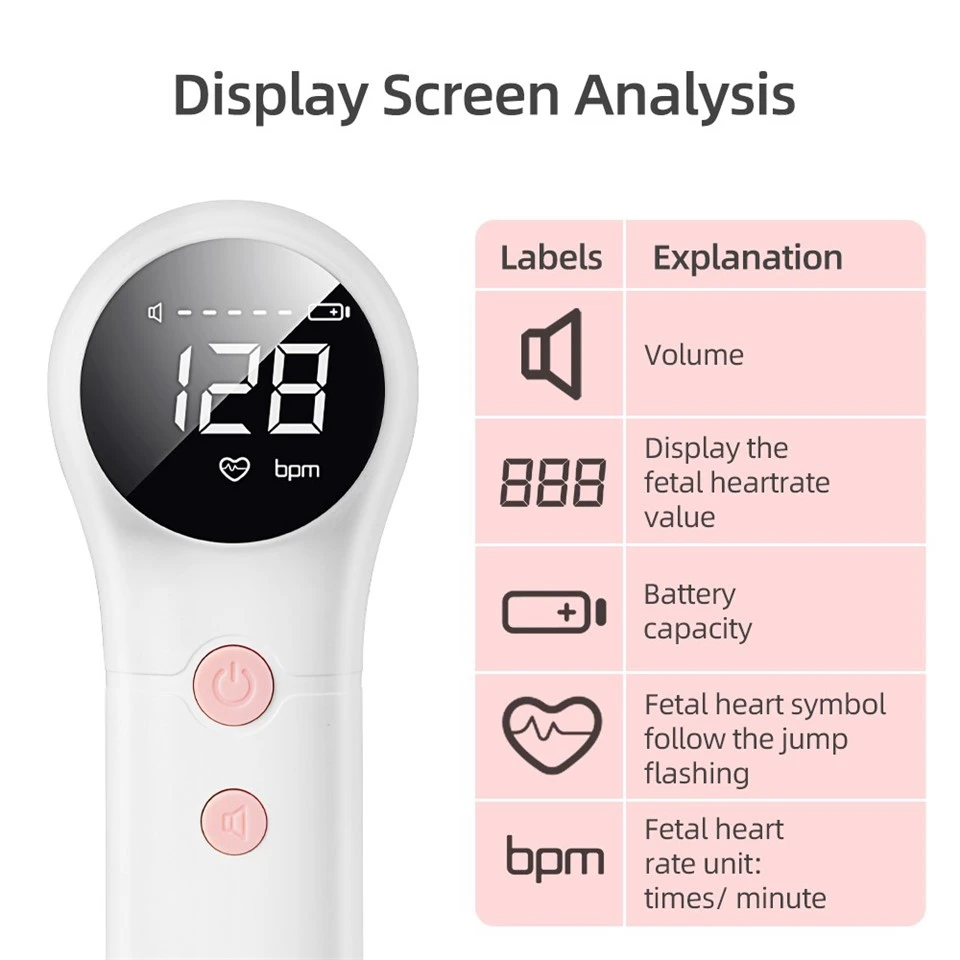
High-definition display
Volume adjustable
Automatic shut down


Components of fetal doppler baby heart monitor
Fetoscope: A cone-shaped instrument similar to a stethoscope that a provider presses against the belly to listen to the baby's heartbeat
Handheld Doppler ultrasound: A device that uses sound waves to measure the baby's heart rate. The provider applies gel to the belly, places the probe in the gel, and the device displays the heart rate on a screen.
Continuous Doppler ultrasound: An electronic device that is held in place on the belly with a strap during labor and delivery. A second strap holds an instrument that measures contractions. Wires from the instruments connect to a monitor that displays the baby's heart rate.
Wire electrode: A device attached to the fetal scalp or other body part
Tocodynamometer: A pressure-sensitive device that measures contractions
Probe and main unit: The two parts of a fetal Doppler that are connected by a cord.
The fetus in early pregnancy is in the stage of organ differentiation, so the indications for use must be strictly followed. Therefore, if there is no clear indication, self-monitoring is not recommended before 15 weeks of pregnancy. For pregnant women after 15-28 weeks of pregnancy, decades of experience in the application of similar products abroad have shown that monitoring 3 times a day for 1 minute each time is safe.


The normal fetal heart rate changes all the time with the different intrauterine environments. The change of fetal heart rate is a manifestation of the normal regulatory function of the central nervous system and the good condition of the baby in the uterus. The mission of fetal heart monitoring is to detect fetal abnormalities as early as possible, take effective emergency measures before the fetus suffers irreversible damage, and deliver the newborn in time to avoid life-long damage.
We advocate more scientific fetal home monitoring, which mainly involves using the fetal doppler baby heart monitor or fetal talker three times a day, morning, noon and evening, for 2 to 3 minutes each time, to monitor whether the fetal heart rate is within the normal range: 120 to 160 beats per minute, so as to understand the health of the fetus. If you have enough time, you can also monitor the correlation between the fetal heart rate and fetal movement changes at home to understand the fetal reserve function.

To avoid possible injury, please be sure to follow the following safety instructions when operating the Fetal Doppler Baby Heart Monitor.
1. The instrument contains precision electronic circuits, please do not open it without authorization.
2. The instrument must be repaired by an authorized qualified engineer.
3. If the instrument is not used for a long time, please be sure to remove the battery in time; the used batteries should be disposed of according to local environmental protection requirements.
4. The fetal heart monitor is designed to work continuously and is a common device. Be careful to avoid splashing.
5. Do not use it in places with flammable gases such as anesthetics, as there is a risk of explosion.
6. Do not throw the battery into the fire to avoid explosion.
7. When using the battery, do not short-circuit or reverse the positive and negative poles.
8. The battery must be stored in a cool and dry environment.
9. Electromagnetic interference - ensure that the instrument is used in an environment that is not affected by strong electromagnetic interference sources, such as wireless transmitters or mobile phones.
10. The instrument is prohibited from collision to avoid damage.
11. The instrument should be kept away from high-frequency surgical equipment when in use.
Company Profile


Send Inquiry
You Might Also Like


