Why Is A Digital Thermometer Better?
Leave a message
Why is a digital thermometer better?
A digital thermometer is simple and convenient to use. It gives faster results than a mercury thermometer which usually takes time to heat up. It is safer as it doesn't contain any harmful chemicals. It gives more precise results than a mercury thermometer.
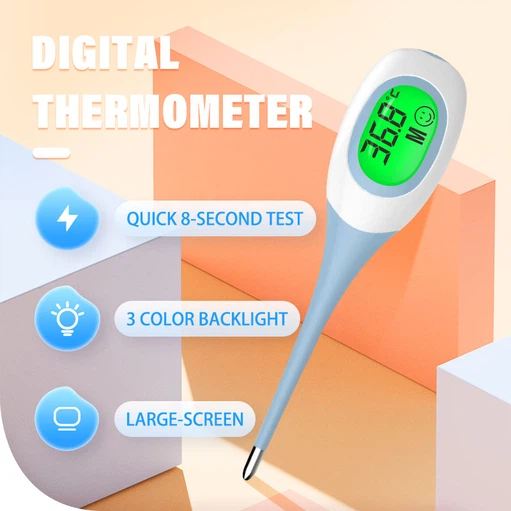
In addition to their accuracy and speed, digital thermometers are also more convenient to use. Many models come with a backlit display, making it easy to read the temperature even in low light conditions. They are also often equipped with memory functions, allowing users to store multiple readings and track temperature trends over time.
Digital thermometers also eliminate the risk of mercury poisoning associated with traditional mercury thermometers. Mercury is a toxic substance and can cause significant harm to human health if it is ingested or inhaled. Digital thermometers, by contrast, use electronic sensors to measure temperature, making them much safer for use in both clinical and home settings.


Digital Thermometer
The working principle of the digital thermometer
Based on the concept of the thermal expansion of materials. When a material is heated, its molecules move faster and start to occupy more space. This causes the material to expand, and this expansion can be measured and used to determine the temperature of the object or environment.
Infrared Thermometer
How does the infrared thermometer work?
It works by detecting and measuring the infrared radiation emitted by an object.
Infrared radiation is a type of electromagnetic radiation that is emitted by all objects with a temperature above absolute zero. The amount of infrared radiation emitted by an object is directly related to its temperature. This is why the infrared thermometer can accurately measure the temperature of an object without touching it.

How do you use the digital thermometer?
Using a digital thermometer is a simple and effective way to measure body temperature. Here are some steps on how to use it properly:
1. Make sure the thermometer is clean and disinfected before use. You can do this by wiping it with rubbing alcohol or soap and water.
2. Turn on the thermometer and wait for it to display 'L' on the screen, indicating it's ready to use.
3. Place the thermometer under your tongue and close your mouth around it.
4. Wait for the thermometer to beep, indicating that it has finished measuring your temperature.
5. Remove the thermometer and read your temperature on the screen. Some digital thermometers may display the temperature in Celsius or Fahrenheit, so make sure you know what unit of measurement is being used.
6. Clean the thermometer with a disinfectant wipe or soap and water after use.
How do you choose a good digital thermometer?
Choosing a good digital thermometer is a crucial task, especially when it comes to health-related matters. Here are some key factors to consider:
Accuracy: The most important factor to consider when choosing a digital thermometer is accuracy. You want a thermometer that provides precise and accurate readings. Look for models that offer at least 0.2 degrees Celsius or 0.4 degrees Fahrenheit accuracy.
Ease of use: A good digital thermometer should be simple to use. It should have a clear display, a user-friendly interface, and easy-to-understand instructions. Some models come with backlights or illuminated displays that are particularly useful in dimly lit areas.
Speed: Choose a thermometer that provides fast and reliable readings. A good digital thermometer should take less than a minute to provide an accurate temperature reading.
Range: Make sure the thermometer you choose has a wide range of temperatures that it can measure. Ideally, the thermometer should be able to measure temperatures from 32°F to 212°F (0°C to 100°C).
Durability: Choose a digital thermometer that is built to last. Look for sturdy materials, water resistance, and easy cleaning options. Also, verify the warranty period to ensure long-term use.