The Best Blood Pressure Monitors For Home Use
Leave a message
The Best Blood Pressure Monitors for Home Use.
Maintaining a healthy blood pressure is key to preventing heart disease, stroke and other health problems. A great way to keep track of your blood pressure is by using a blood pressure monitor at home. With advancements in technology, blood pressure monitors have become more affordable and easy to use. Here are some of the best blood pressure monitors for home use:
1. Omron 10 Series Wireless Upper Arm Blood Pressure Monitor: This is a highly recommended blood pressure monitor that is easy to use and provides accurate readings. It has a wireless feature that allows you to track and store your readings on your smartphone or tablet. Additionally, it can store up to 200 readings for two users.
2. Welch Allyn Home 1700 Series Blood Pressure Monitor: This blood pressure monitor uses SureBP technology to provide fast and accurate readings. It also has a large, easy-to-read display and can store up to 100 readings for two users.
3. Greater Goods Blood Pressure Monitor: This affordable option is perfect for those on a budget. It is easy to use and provides accurate readings. It also comes with a large, easy-to-read display and can store up to 60 readings for two users.
4. QardioArm Wireless Blood Pressure Monitor: This is another highly-rated blood pressure monitor that syncs with your smartphone or tablet. It has a sleek design and is portable for on-the-go use. It can also store up to 120 readings.
5. A&D Medical Deluxe Connected Blood Pressure Monitor: This blood pressure monitor connects to your smartphone or tablet via Bluetooth and stores up to 100 readings for two users. It also has a large, easy-to-read display and provides accurate readings.
Investing in a blood pressure monitor can help you to monitor your blood pressure levels and take necessary steps to maintain a healthy lifestyle. With a range of affordable options available, picking the right one for you can help to improve your wellbeing.

Take a look at our products!


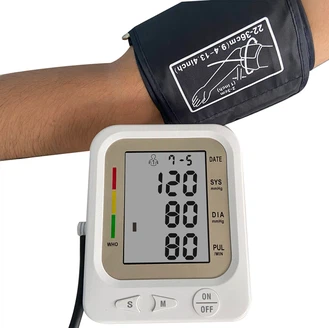
Specifications:
1. Measurement range: 0-300 mmHg (Pressure); 30-180 beats/min(Pulse)
2. Accuracy: ±3 mmHg(±0.4kpa)(Pressure); ±5%(Pulse)
3. Automatic measurement and power-off
4. 99 memory in 2 groups
5. Measurement time: 100-120s measurement
6. 4*AAA battery or 6V USB
Is it necessary to measure your blood pressure at home?
Measuring your blood pressure at home can be a beneficial habit. It can provide you with an accurate reading of your blood pressure, which can help you identify potential health problems early on. High blood pressure or hypertension is a common health issue that can lead to serious health problems such as stroke and heart disease. Measuring your blood pressure at home regularly can help you stay on top of your health and take necessary measures to prevent any potential issues.
Moreover, measuring your blood pressure at home can also help you monitor the effectiveness of any medications or lifestyle changes you might be implementing to manage your blood pressure. It can provide you with valuable data that you can share with your doctor, who can then make informed decisions about your health.
Home monitoring blood pressure can also help you reduce the stress and anxiety that can be associated with visiting a doctor's office. By taking measurements at home, you can avoid any white-coat effect, which can result in elevated readings that are not representative of your usual blood pressure.
In conclusion, measuring your blood pressure at home is an easy and cost-effective way to stay on top of your health and prevent potential health problems. By monitoring your blood pressure at home, you can take steps to manage it and lead a healthier lifestyle.
How do you use the blood pressure monitor?
Using a blood pressure monitor is an easy and simple process that can be done at home. Here are some steps to follow:
1. Firstly, sit comfortably and relax for about 5 minutes before taking the measurement.
2. Place the cuff on your upper arm and secure it in place. The cuff should be positioned directly on the skin and not over clothing.
3. Switch on the monitor by pressing the power button.
4. Ensure that the monitor is properly calibrated and set up as per manufacturer's instructions.
5. Press the "start" button to initiate the measurement process.
6. Stay still and remain calm during the process until the reading displays.
7. Record the result and compare it with the normal range of 120/80mmHg.
8. If the reading deviates from the normal range, consult your healthcare professional for further advice.
Using a blood pressure monitor regularly can help you to monitor your blood pressure levels over time. As a result, you can take more effective measures to maintain healthy blood pressure levels and improve your overall health and well-being.
How do you choose a good blood pressure monitor?
Pick a top-scoring model that has the features you need and that will make testing easiest for you. For example, some models allow you to store readings for more than one user. All the models we recommend earn Excellent ratings for accuracy, but there are other factors to consider, too. Follow these tips to help you select the best blood pressure monitor for you.
Check the Fit
Make sure the blood pressure monitor you choose has a cuff that fits the circumference of your upper arm or wrist. (Use a tape measure to be certain.) Using a cuff that’s the wrong size can result in inaccurate readings. Most of the arm models we tested have two cuffs or a cuff that can be adjusted to fit most people. Wrist models also fit most people.
Consider Cost
The recommended models in the ratings (available to members) were priced from $40 to $100. But shop around. And find out whether your insurance covers blood pressure monitors.
Choose One That’s Easy to Use
The display on the monitor should be easy to read. The buttons should be large and intuitive. The directions for using the cuff and operating the monitor should be clear.
Select the Features You Need
There are many features to look for when selecting a blood pressure monitor. Here are some to consider: an irregular-heartbeat detector, a risk-category indicator, multiple user memories, multiple cuffs, memory download capability, a large-digit display, and a data-averaging function. For more details, check the specs section of our ratings.